|
With the three statement plays Fugard experimented with improvisation together with actors John Kani and Winston Ntshona and came up with some of his most powerful work. These plays directly attack the apartheid laws of South Africa at that time. "These works avoid the pitfalls of didacticism, a real danger because of their subject matter (the "pass" law and the political prison on Robben Island, respectively) by transforming the real social ordeal of the doubly real people- the actors and their roles- into artistic and therefore meaningful structures" (African Literatures in the 20th Century, General Editor Leonard S. Klein).
Sizwe Bansi is Dead 1972 "Good. Let me just take your name down...What is your name? Your name please! Come on, my friend. You must surely have a name". In the play Sizwe Bansi (the original title used Banzi) can only gain work and survive by taking on a dead man’s identity. The play was based on improvisations by Fugard, John Kani and Winston Ntshona and first performed at The Space in Cape Town, South Africa in 1972.
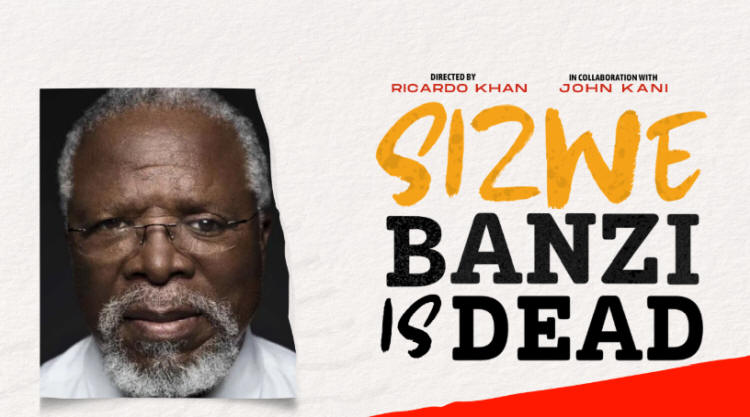
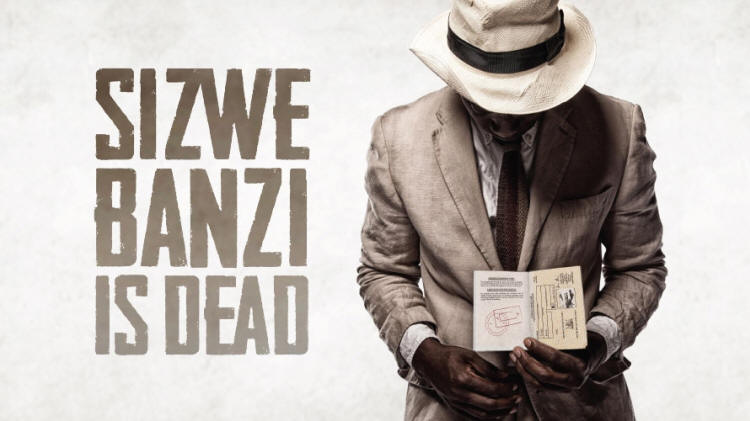
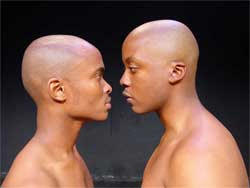
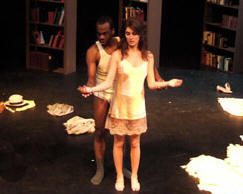
"It dared to critique, through a sometimes comic parable, the injustices of that regime- and to a mixed Black and white audience, no less, revolutionary for the time. The actors were arrested after the premiere performance and Kani was kept in solitary confinement for 23 days (Karen Fricker, Toronto Star, 7 June 2023, click here). "...sometimes you must die so you can live... The play is oddly constructed and baggy, but its simplicity should not be mistaken for a lack of sophistication, and its continuing relevance will be apparent to anyone who reads a newspaper and knows that the legacy of apartheid means that equality between black and white is still far away" (Lyn Gardner, 16 Feb 2014, The Guardian, click here). "Sizwe Bansi Is Dead isn't so much a play within a play as a play without a play. The two sections never merge, nor does conflict emerge from dramatic development. We remain on the outside listening in - but the words we hear gnaw at us. The subject is upsetting, but the playwrights' tone is upbeat. The real theme here is the resiliency, the endurance of the human spirit" (Alvin Klein, NY Times, 18 Jan 1981). The first image is from the Crossroads Theatre Company, 2026 click here. The second image is from the Young Vic/ Eclipse Theatre Company co-production 2014.
"When you get in front of them, sure they'll laugh...Nyah! nyah!...they'll laugh. But just remember this brother, nobody laughs forever! There'll come a time when they'll stop laughing, and that will be the time when our Antigone hits them with her words"
Two prisoners on Robben Island prison camp rehearse a performance of Antigone. One discovers he will shortly be released, the other is a lifer, so there is a meeting of hope and despair. The harshness of the camp is conveyed in long mime sequences. The relationship between the prisoners reminds me of the two brothers in Blood Knot. Another comparison is Jean Genet's Death Watch. The premiere was in the Space Theatre in Cape Town with Fugard directing Kani and Ntshona. The title was given as Die Hodoshe Span since any references to Robben Island prison camp would be unacceptable to the government. The play was revived in London in February 2000 with Kani and Ntshona and Fugard acting. It played to full houses in the Royal National Theatre with both actors demonstrating their towering acting abilities.
John Kani says (quoted in The Crossings Project): What we discovered after creating Sizwe Bansi was that we couldn’t have the text written down. This was because it would have been a document; it would have meant that the police would have evidence that could be presented to a District Attorney who might lay charges against us. So we kept continuing to improvise according to the interactions and response with the audience. That way we used our life experience, structured it around a story, to take the audience on a journey through to the end of the evening. After Sizwe Bansi Is Dead, we decided to explore the subject of Robben Island. To start off with, we put a blanket on the ground. We stood on it and began to move with Athol watching. We began to halve the blanket, halve the blanket, until there was just enough space for four feet to stand. We realised the restriction of space, and there it was – confinement. And there it was – prison.
"If you're going to dream,
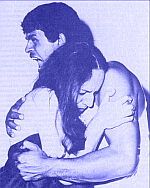
give yourself five rooms man" Two lovers lie together and talk. The police enter and arrest them, as one is white the other coloured. They each are forced to give statements. Fugard directed himself and Yvonne Bryceland in the premiere in Cape Town in 1972. In London Fugard directed Ben Kingsley in his role.
|